
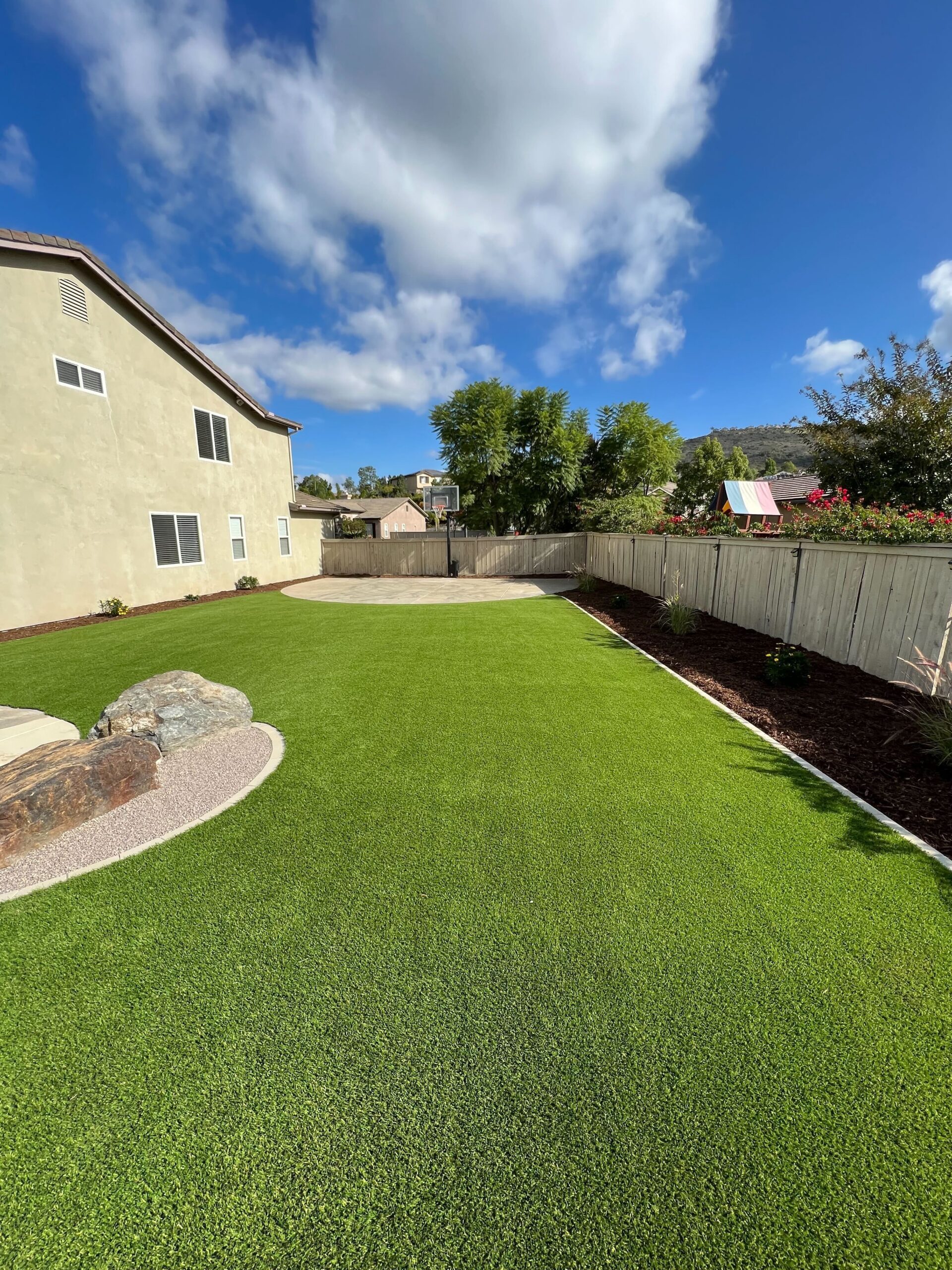
Evergreen Front and Back Yards, San Marcos Highlands
This finished project was a $80k-$90k build.
Project Gallery
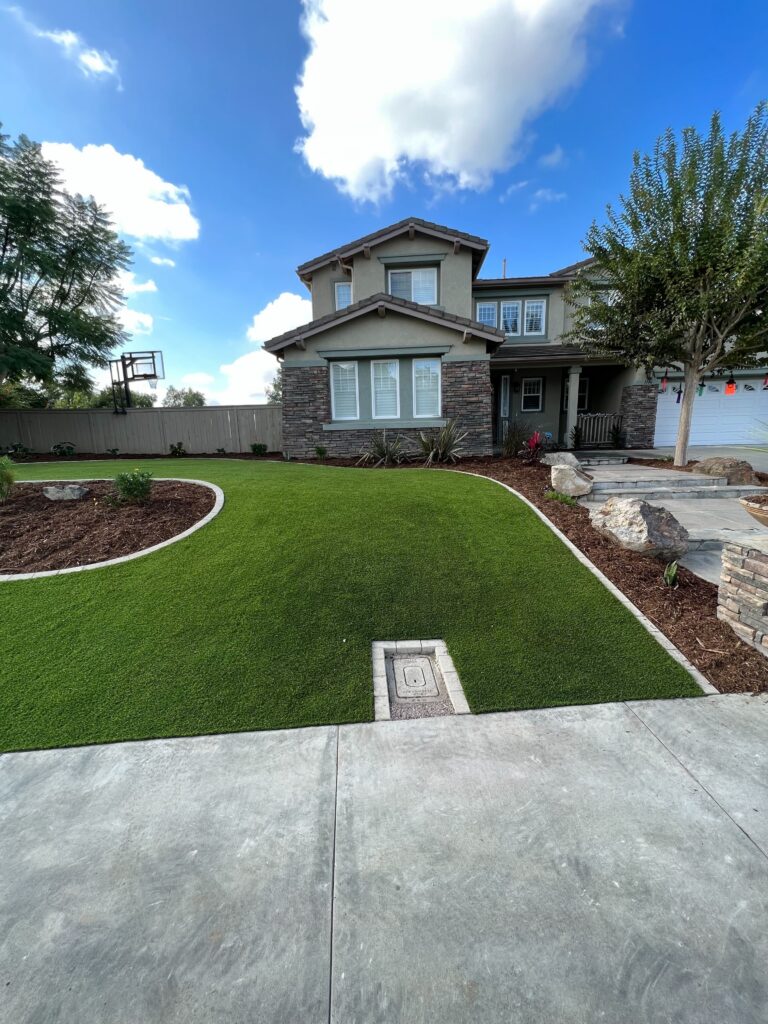
Front yard of a two-story residence showing newly installed artificial turf with a concrete driveway, curved mulch planting beds, and stone veneer retaining/planter walls. An irrigation/utility access box is visible near the sidewalk and the overall installation appears finished and clean.
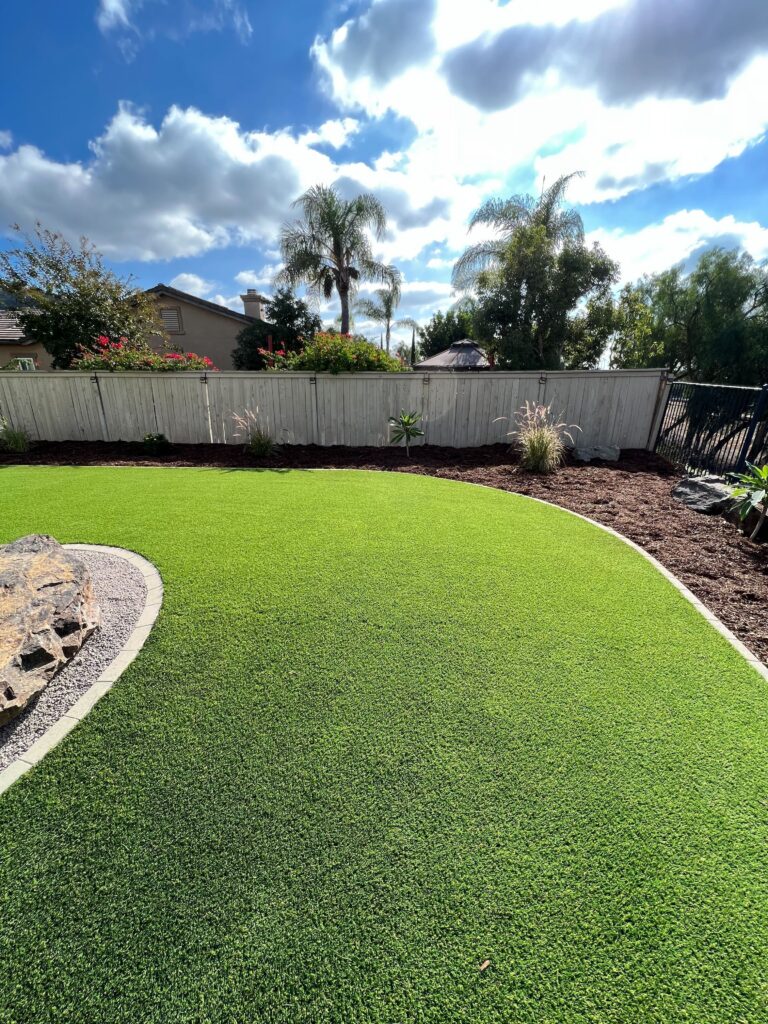
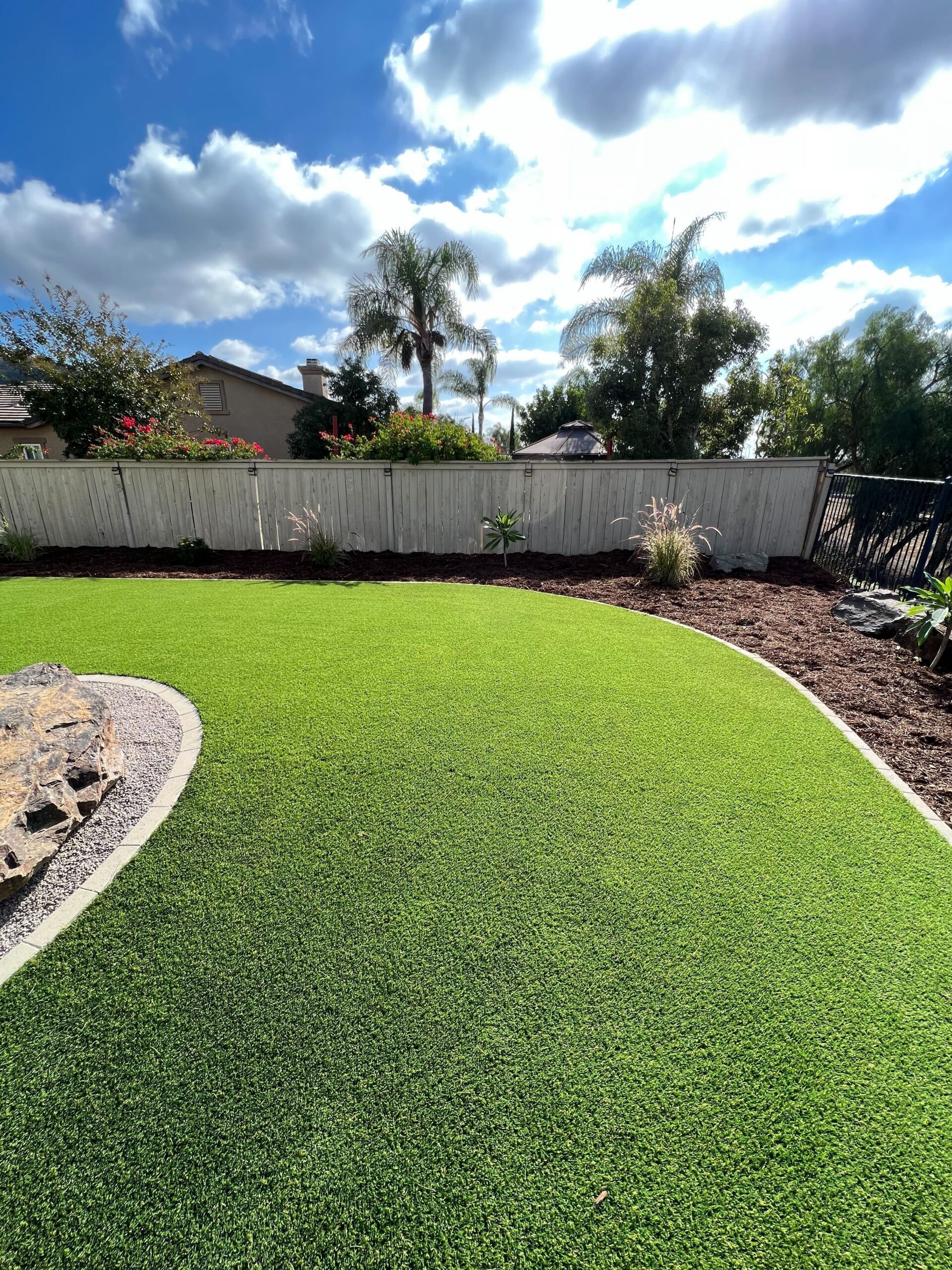
Residential backyard showing newly installed artificial turf with a smooth curved edge transitioning to a mulch planting bed and a small decorative rock area. The installation appears finished with clean edges along a white perimeter fence and several palm and shrub plantings in the bed.
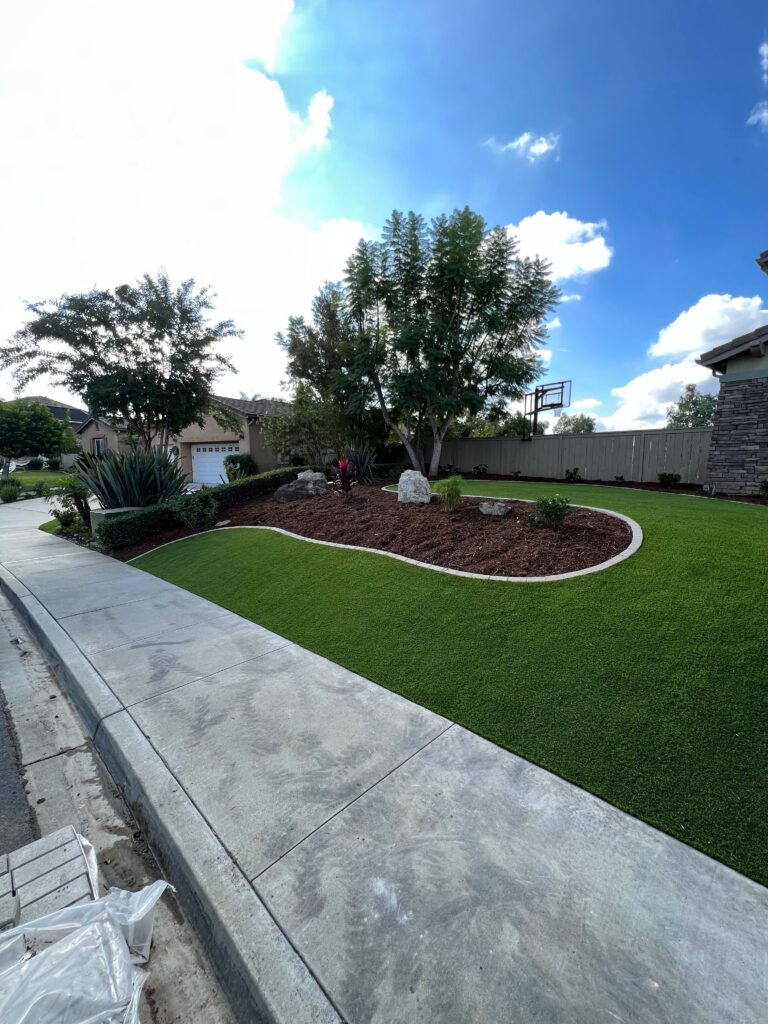
New front-yard turf lawn with a curved concrete mow strip edging the mulch bed around the mature tree.
Project Snapshot
Project Story
Overview
Front and back yards laid with 3,449 sf of Imperial Desert Rye over a full gopher-mesh underlayment, framed by 493 lf of poured concrete mow strip and inset with 24x24 pewter stepping stones. Seven drip-irrigated planting zones, 450 sf of AZ river rock, and 59 five-gallon shrubs replaced the failed lawn over 25 working days — a low-water reset that holds its shape year-round.
Front and back look the same now and we stopped thinking about the lawn entirely.
The Challenge
- 3,449 sf of patchy grass and bare dirt across the front and back yards — now Imperial Desert Rye turf — left the property reading neglected.
- The existing irrigation lines were in disrepair, leaving planter beds without reliable water and forcing 7 drip valves to be added mid-scope.
- Overgrown trees and dense shrubs had taken over portions of the yard, blocking light before the 59 five-gallon shrubs and 450 sf of AZ river rock went in.
What Changed
How INSTALL-IT-DIRECT Helped
Over 1,000 five-star reviews and 1,500+ San Diego homeowners served.
Design & Build
The Plan
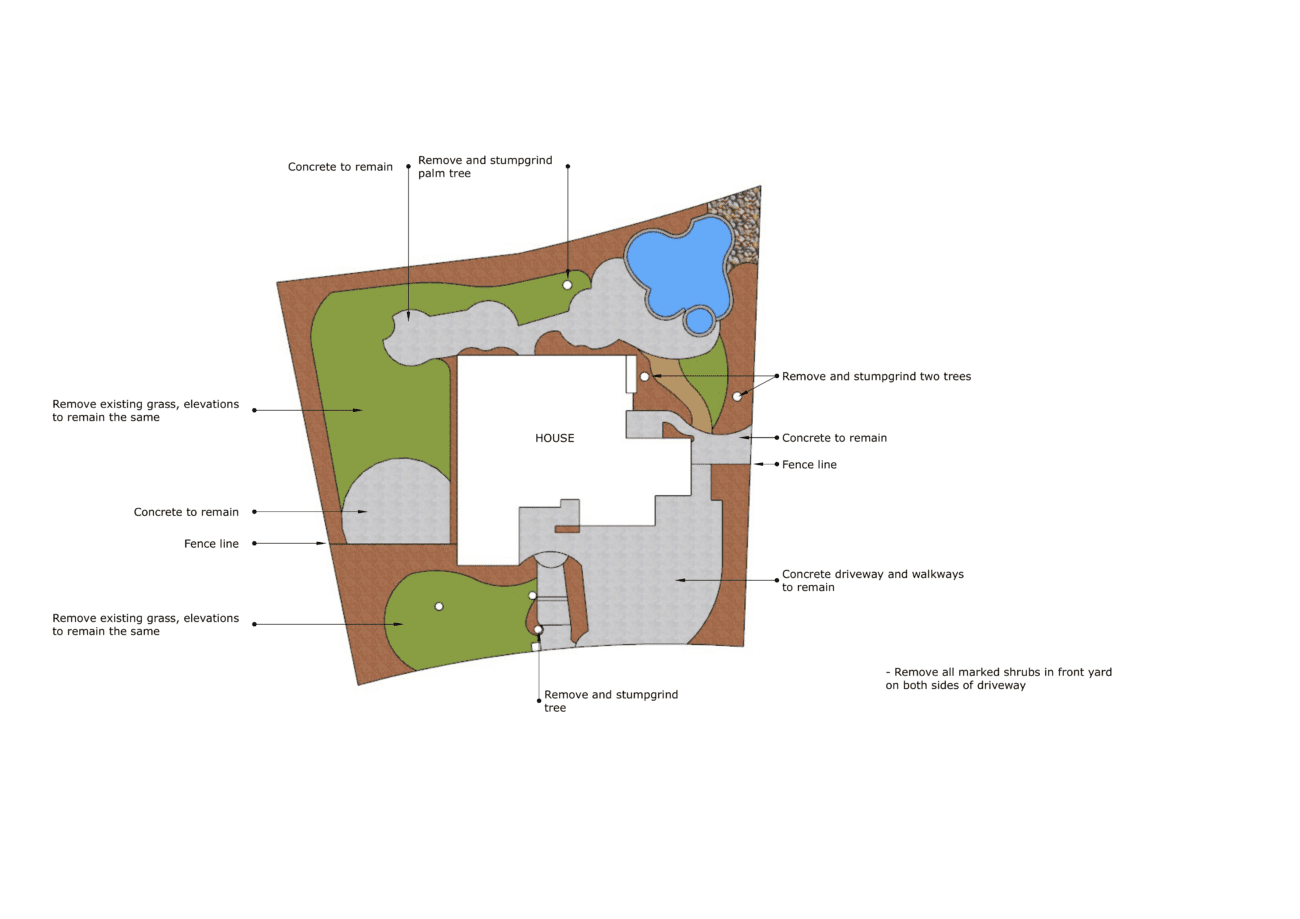
Layout planned for continuous turf coverage across both front and back yards, with curved concrete mow strip edging defining transitions between turf, planting beds, and hardscape.
Imperial Desert Rye turf selected for its natural blade texture and durability in San Diego’s inland climate, installed with silica sand infill for blade support and resilience.
Gopher mesh (3,449 sf) specified as an underlayment layer beneath the turf to prevent burrowing damage, a standard precaution for this inland San Marcos area.
Seven drip valve zones with Netafim drip line and pressure regulators installed to serve new planting beds, replacing capped overhead sprinklers.
450 sf of AZ river rock (1/4″–1/2″ grade) used to accent planting areas and transition zones throughout the property.
24×24 pewter-color stepping stones (Home Depot, 2″ thick) set flush into the turf to create walkable paths without interrupting the lawn plane.
See the 2D plan drawing
The Build
Tree Removal and Demo
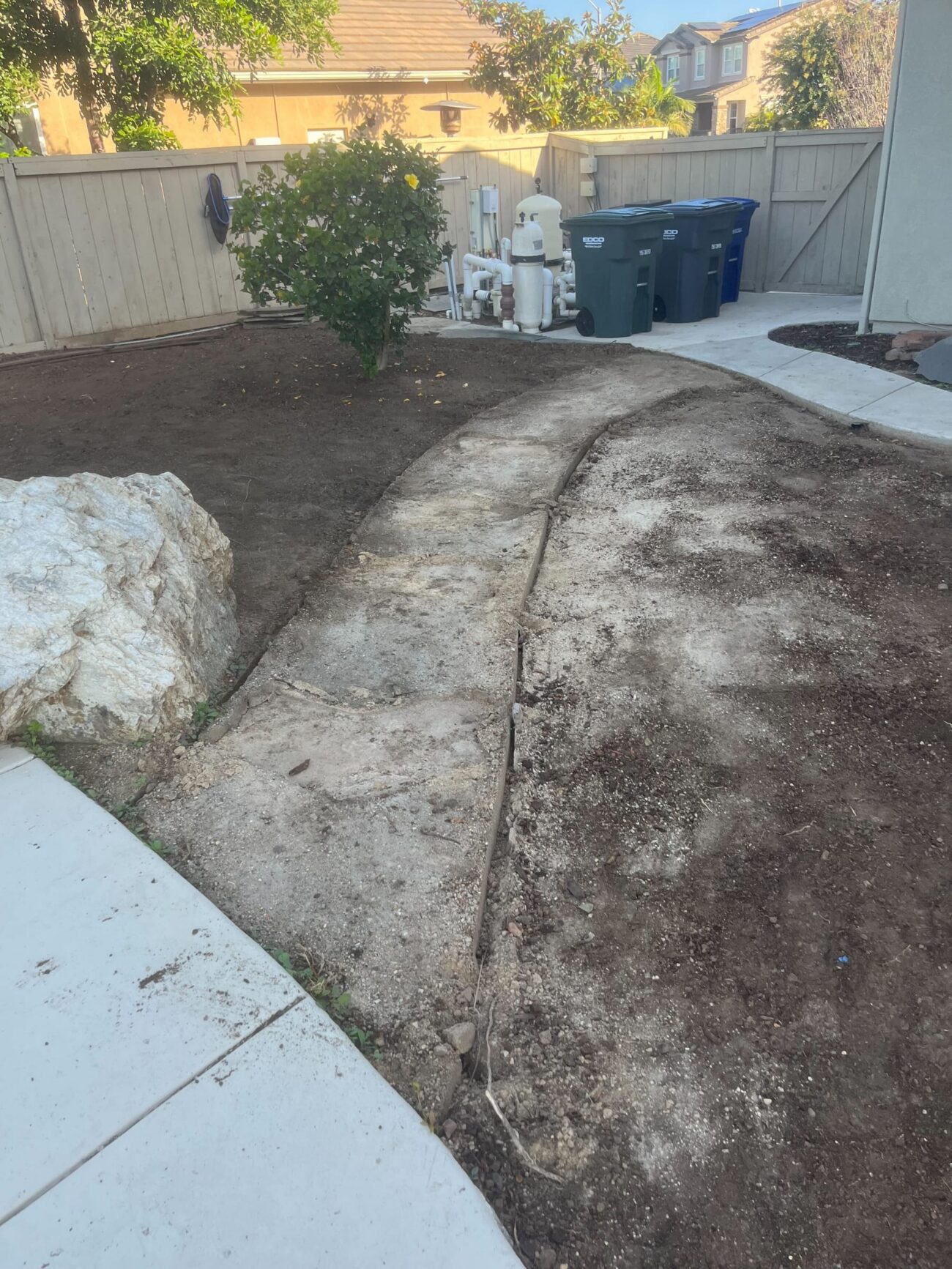
Work began with tree trimming, removal, and stump grinding of marked trees and large shrubs. Demolition labor covered roots, soil, and existing organic material across both yards. A large front rock was relocated as part of site preparation.
Grading and Base Preparation
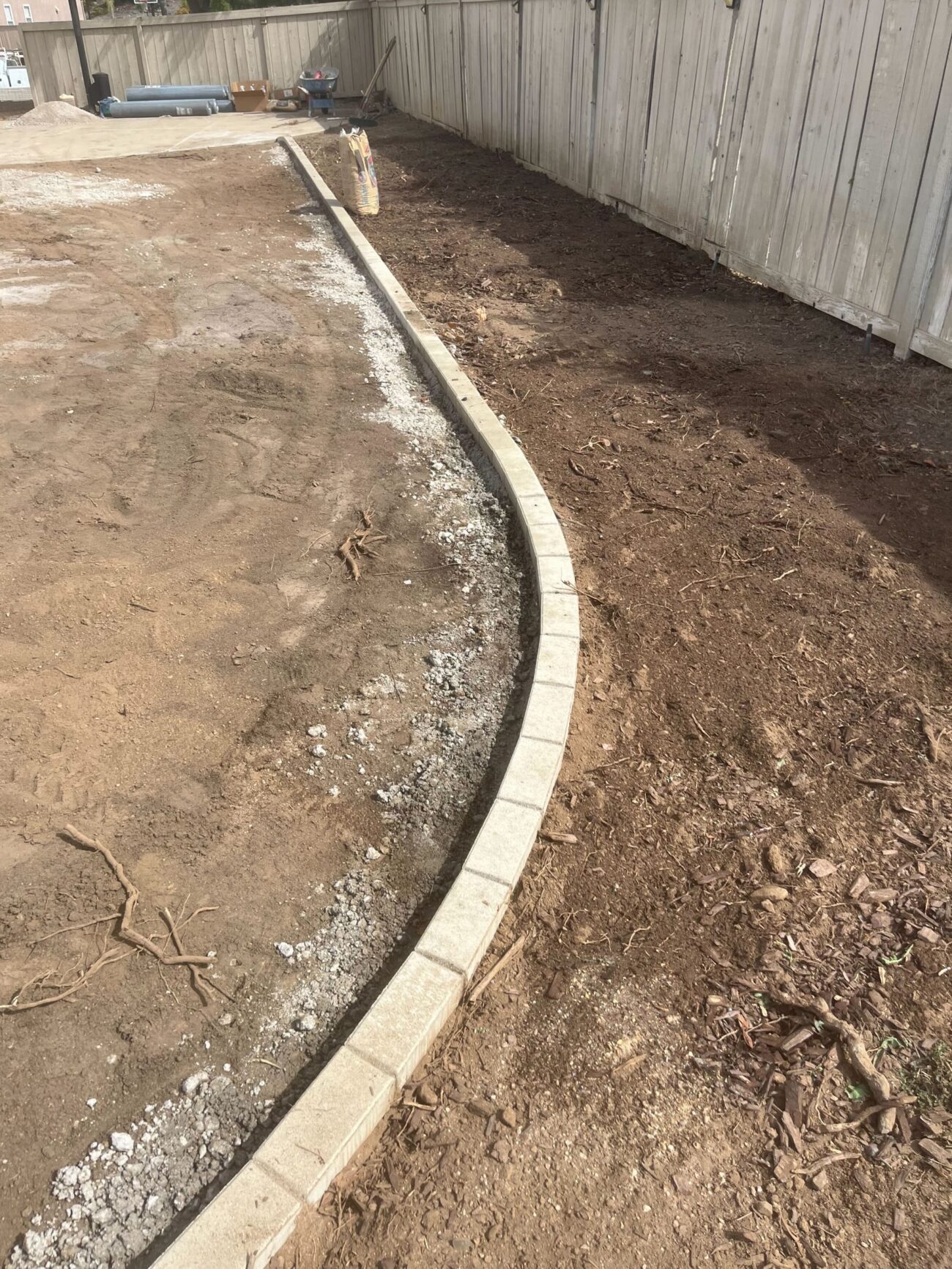
After clearing, the subgrade was excavated and graded across both the front and back yard turf areas. Compacted aggregate base was spread and leveled, and concrete mow strip edging was formed and poured along all turf perimeter boundaries, including curved transitions at the patio and planting beds.
Gopher Mesh and Turf Installation
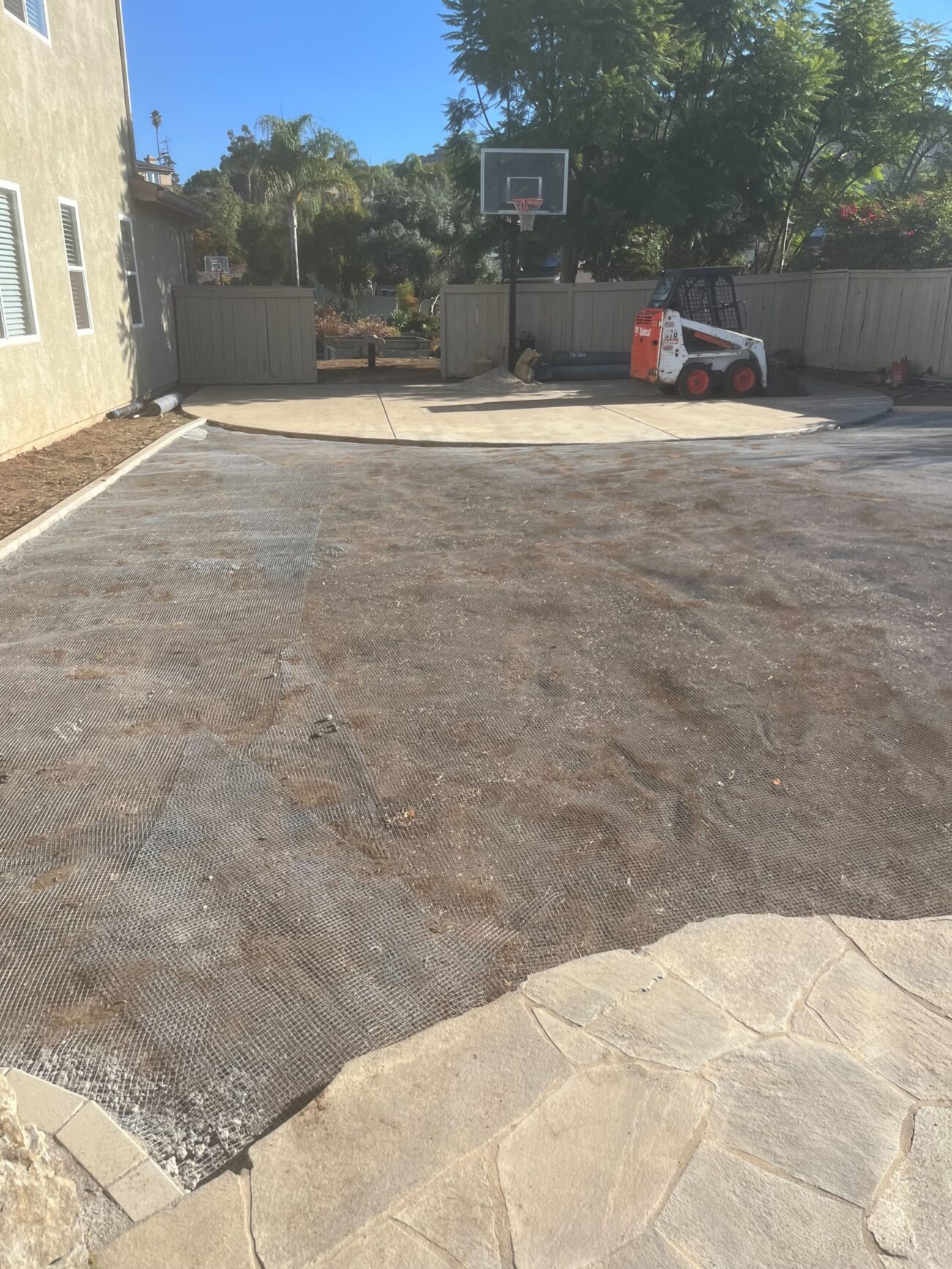
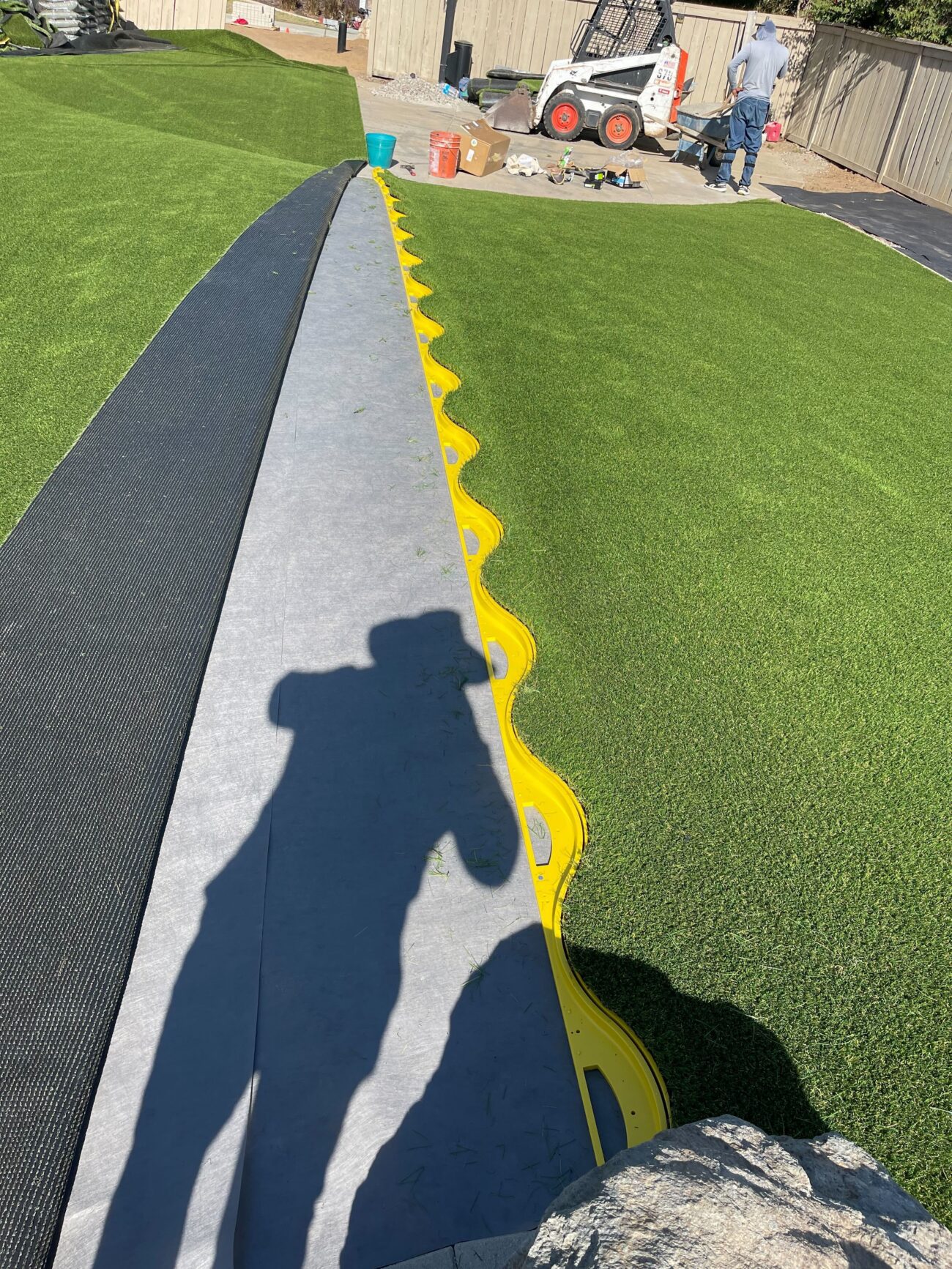
Gopher mesh was laid across the full 3,449 sf turf footprint and secured before turf rolls were delivered and positioned. Turf seams were joined with self-adhesive seam tape, secured with nails and staples, and silica sand infill was brushed in. Stepping stones were set flush into the turf field. Turf installation across both yards was completed by the crew in the final install phase.
Planting and Irrigation
Fifty-nine five-gallon shrubs were planted into prepared beds with potting soil and bark mulch. Seven drip valve zones were installed with Netafim drip line, pressure regulators, and connections to the existing water source. Existing overhead sprinkler heads were capped across approximately 100 points.
Investment
What would a similar project cost in San Marcos?
Toggle components on/off to estimate your project
Frequently Asked Questions
How much does artificial turf installation cost for a full front and back yard in San Marcos?
A full front-and-back yard conversion like this one in San Marcos Highlands, covering roughly 3,449 square feet of turf with concrete mow strip edging, gopher mesh underlayment, stepping stones, and seven drip irrigation zones, typically falls in the $80,000–$90,000 range when combined with planting, tree removal, and site work. Turf-only projects on smaller lots start significantly lower. The biggest cost drivers are total square footage, the condition of existing irrigation, and whether trees or significant demo work are required.
Does an HOA in California have to allow artificial turf?
California Civil Code Section 4735 generally limits the ability of HOAs to ban artificial turf outright, though HOAs may impose reasonable quality and appearance standards (such as minimum pile height or color). The current state of HOA artificial-turf rules is property-specific, so verify your HOA's current provisions with your contractor and your HOA board before assuming any particular outcome. This project is located in an HOA community in San Marcos, and the turf installation proceeded after the HOA matter was resolved.
How do I maintain artificial turf after installation?
Artificial turf requires minimal maintenance compared to natural grass. On a project like this one using Imperial Desert Rye with silica sand infill, routine care includes occasional rinsing to remove dust and debris, light brushing to keep the blades upright, and removing leaves or organic material from the surface. There is no mowing, no watering of the turf itself, and no fertilizing. The drip irrigation on this property runs to the planting beds only. Periodic inspection of seams and edging is recommended, especially in the first year after installation.
How long does a large artificial turf project take to complete in San Marcos?
This project ran 25 working days (about 4.5 calendar weeks) from initial site setup through final checks. That included tree removal and stump grinding, full-yard grading, concrete mow strip forming and pouring, gopher mesh and turf installation across both yards, planting, and drip irrigation installation. Timeline can vary based on scope changes, material deliveries, and HOA coordination.
What is gopher mesh and do I need it under artificial turf in San Marcos?
Gopher mesh is a heavy wire barrier installed between the compacted subbase and the turf backing to prevent burrowing animals from tunneling up through the lawn. In San Marcos and other inland San Diego communities where gophers and ground squirrels are common, it is a practical long-term investment. On this project, 3,449 square feet of gopher mesh was installed under the full turf footprint before the turf rolls were placed. It adds labor cost but protects the turf from below-grade damage that would otherwise require pulling up and re-installing sections.
Can I keep my existing irrigation system when switching to artificial turf?
Most overhead sprinkler systems are capped or removed during a turf conversion because turf does not need irrigation and wet soil under the backing can cause issues over time. On this project, approximately 100 existing sprinkler heads and lines were capped. New drip irrigation was installed across seven zones specifically to water the planting beds, a much more efficient approach than overhead spray. If your property has existing irrigation infrastructure in poor condition, that should be assessed before installation begins.
Your Outdoor Project in 3 Simple Steps
Design
We listen to your vision, assess your space, and create a custom design that fits your lifestyle and budget.
Build
Our experienced crews bring the design to life with premium materials and expert craftsmanship.
Enjoy
Step into your transformed outdoor space and start making memories with family and friends.
Your Project Manager

Troy MacMillan
A San Diego native with more than 20 years in landscape construction, Troy brings seasoned craftsmanship to every build. A devoted husband and father of two, he carries the same care from the job site to his weekend farm.
More Projects
More from Troy MacMillan
Turf, River Rock & Pavers: Carlsbad Front Yard
Carlsbad
Oceanside Paver Driveway, Turf Grid, and Front Entry Remodel
Oceanside
Mixed Angelus Pavers with Stone Pillars in Vista
Vista
Paver-and-Turf Grid Backyard in Vista
Vista
A 20-Foot Outdoor Kitchen Under a Pergola
Carlsbad
From the Front Door to the Pergola, One Paver
San Marcos
Ready to Transform Your Outdoor Space?
Let's discuss your project and bring your vision to life.